






Reliability & Customer Satisfaction
Reliability & Customer Satisfaction
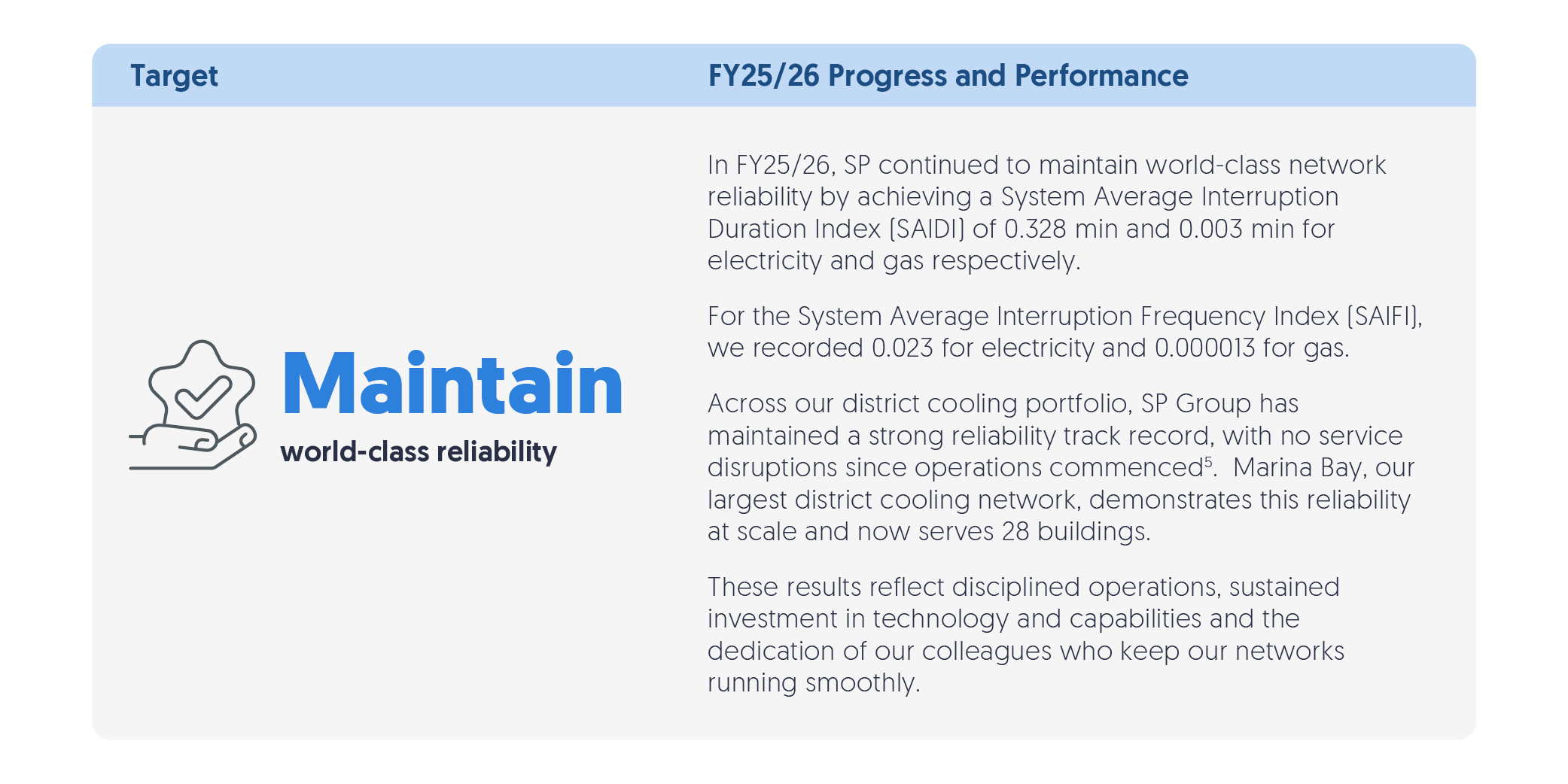
Reliability and customer satisfaction are central to SP Group’s operations. By delivering reliable energy and utility services, SP Group strengthens its reputation and builds community trust. Investments in robust infrastructure, innovative grid technologies and low-carbon energy solutions enhance service reliability and system performance, enabling SP Group to operate efficiently and respond effectively to customer needs. These capabilities, in turn, raise customer satisfaction, build long-term loyalty and position SP to capture new growth opportunities as a trusted and dependable energy and utility service provider.
Key Initiatives
Battery Energy Storage System at Kallang, Singapore
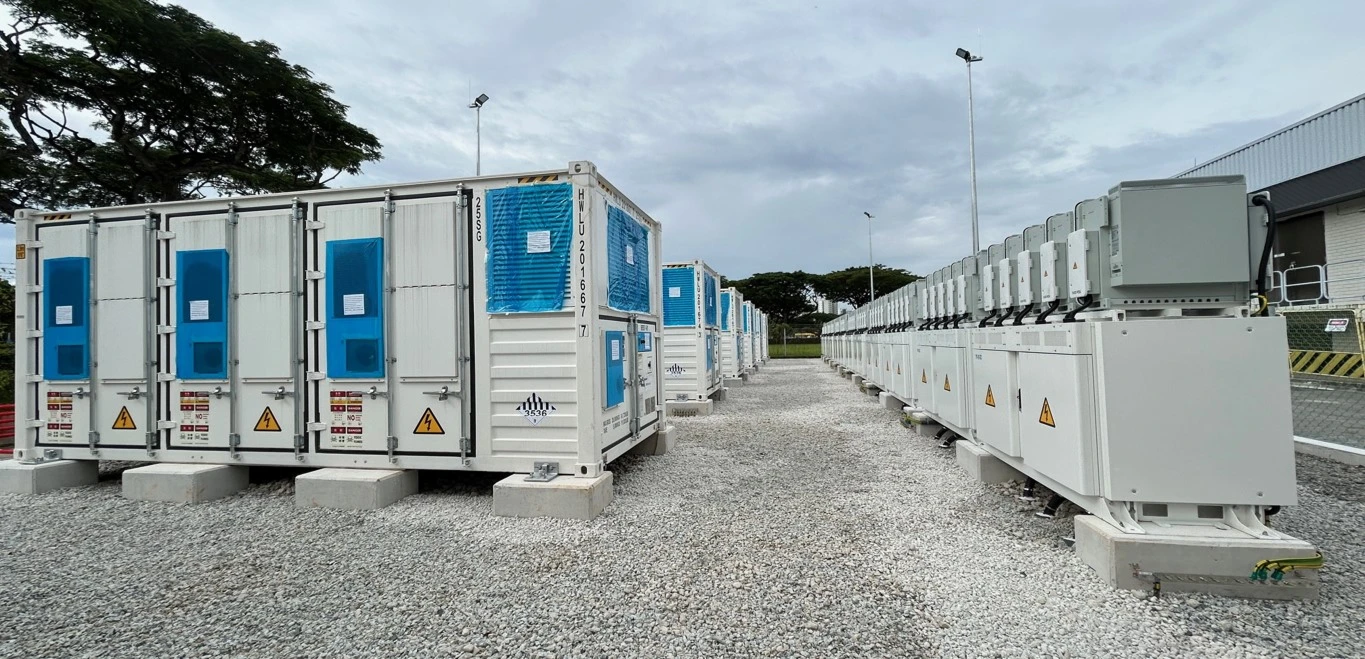
Located within Kallang Industrial Park, SP Group’s Battery Energy Storage System (BESS) represents a practical step towards strengthening the resilience and flexibility of Singapore’s electricity grid. The development of the Kallang BESS builds upon SP Group’s pioneering experience from the earlier Woodlands BESS, translating operational learnings from Singapore’s first utility scale energy storage system into a more advanced and scalable deployment supporting grid stability. While physically compact and housed within a series of containerised units, the facility is designed to play a critical system role by storing electricity when demand is low and releasing it within seconds when the grid requires support.
This fast response capability is particularly important as Singapore integrates higher levels of weather dependent renewable energy, such as solar power. By responding rapidly to fluctuations in supply and demand, the Kallang BESS helps to stabilise grid operations and supports the secure electricity delivery under more dynamic operating conditions.
The Kallang facility comprises several battery storage containers that are integrated with a Power Conversion System (PCS). The PCS manages the conversion between direct current (DC) and alternating current (AC), enabling stored electricity to be safely and efficiently transferred between the batteries and the national grid. This configuration allows the BESS to act as a fast-acting grid support asset, capable of injecting or absorbing power in response to system needs.
Such responsiveness strengthens operational resilience by:
- Supporting grid stability during sudden changes in load or generation
- Complementing conventional grid assets that may respond more slowly
- Enhancing the system’s ability to manage variability arising from renewable energy integration
Beyond its physical installation, the Kallang BESS also serves as an operational learning platform for SP’s engineers and system operators, further building capability in deploying and operating energy storage solutions that can support grid resilience at scale over time.
Building Capabilities to Sustain Grid Reliability in the Evolving Energy Landscape
As Singapore advances towards a low-carbon and increasingly complex energy system, SP Group continues to invest in building a future-ready workforce. Recognising that engineering, digitalisation and system planning capabilities are critical to sustaining grid reliability while integrating new energy solutions, we adopt a multi-layered approach to capability development, spanning internal workforce transformation, applied research partnerships with an institute of higher learning and the upcoming SP Technology Lab, innovation platforms and technical leadership pathways.
SP Group continues to strengthen its core engineering workforce through structured capability development and workforce transformation initiatives.
Key programmes, including technical competency frameworks and structured development pathways for engineers, support continuous upskilling and role readiness as operating environments evolve.
These efforts are complemented by organisation-wide initiatives such as the Company Training Committee (CTC) and Project FUSION, which integrate skills upgrading with job redesign to enhance productivity and support workforce transformation.
How this ‘grid doctor’ maintains the health of Singapore’s electricity network so everything stays on
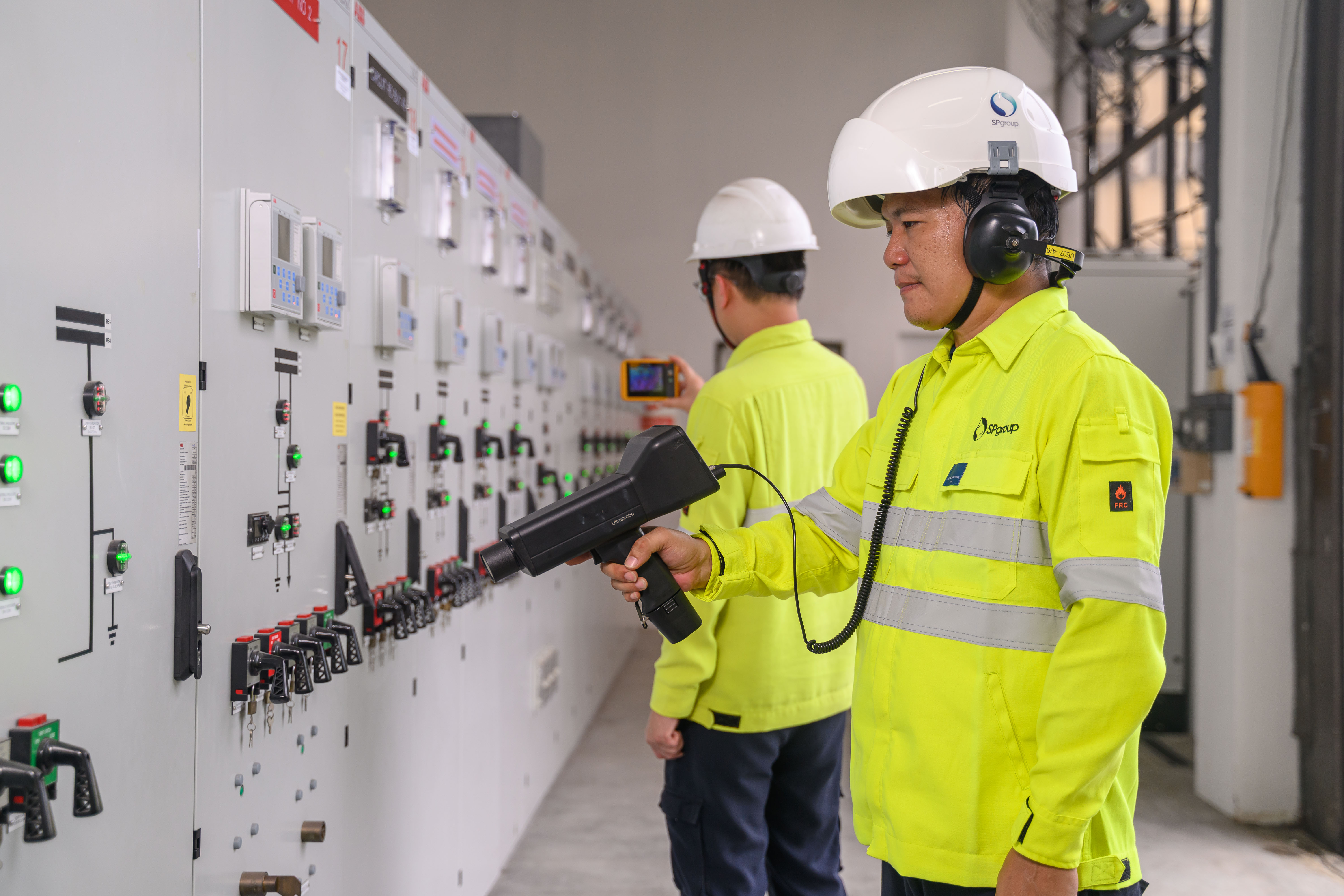
In 2025, SP Group’s customers experienced an average electricity interruption of nineteen seconds. Behind this performance are engineers and technical officers like Mr Eric Lee, who conduct “health checks” on critical equipment to detect early signs of deterioration before they escalate into faults.
Previously, such checks relied on manual inspections using handheld detectors, acoustic sensors and thermal scanners in substations. This work was labour intensive, required close physical access to equipment and produced only snapshot readings. Since 2020, SP has progressively installed smart sensors directly on key assets such as distribution switchgear and cables. These sensors continuously monitor equipment conditions, trigger real-time alerts when anomalies are detected and provide data that supports predictive maintenance.
The new system has improved safety and efficiency, saving more than 1,000 man-hours annually and shortening response times. Technical officers like Mr Lee are now able to focus on higher value tasks such as diagnosing complex issues and localising defects. Through training and on-the-job experience, they have also strengthened their digital and data analytics skills, supporting SP’s broader drive to use innovation and technology to “keep the lights on” and maintain a safe, reliable electricity supply for Singapore.